Showing posts with label Metals. Show all posts

Sunday, October 31, 2010

Peru's metals production numbers for September 2010 are poor

Here are the latest Peruvian production numbers for its five main metals, with the September 2010 numbers just published by the Ministry of Energy and Mines (MEM). All the charts run from January 2009 to Sept 2010 for a bit of context and please note that the Y axes don't start at zero. Not trying to fool you into thinking something different, just moving the baselines up to allow the month-on-month contrasts to show up better.

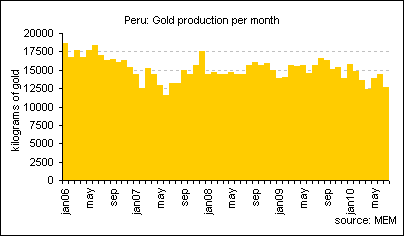
The two biggest money-earners in Peru are (by quite some way) copper and gold. Here we see how gold production has evolved and we see that things are still depressed.

Copper is a little better, but at under 100,000mt last month (98,182mt to be exact) they're not setting any production records, either.

Zinc is at the low end of its normal fluctuations.

Lead continues to drop away quite sharply.

Silver numbers aren't that great, either.

Overall, Peru's September numbers for metals production were pretty poor, but you won't get to hear about that....what you'll get pushed at you is the rise in export revenues in gold, copper etc. This is because Peru is getting really, really lucky at the world market level and the rises in metals prices are covering the production shortfalls (for example, this.....
....is how IKN calculates Peru's gold production by value, factoring in the LME average fix for each month to the production levels reported.....U$1,300/oz+ gold papers over a lot of cracks, doesn't it?)

So remember the metals slump when you hear about the GDP growth slowdown for September that will come out in a couple of weeks time, or while reading how the country ran a fiscal deficit of U$233.3m in the same month.

Wednesday, September 1, 2010

More Peru mining production stats

So I put up the post just an hour ago that clearly shows how Peru's exports are riding their luck and immediately (and I mean within half an hour) the "you're just cherrypicking" mail arrives from one the sillypeople that is ignorant to stick up for the corruptos running Peru. So let's first point out this:

Ahhhh I feel better now. Let's plough straight on with the monthly metals production figures for Peru in the period 2006 to date. Starting with copper, the only one that has made some sort of significant move (and I betcha that you can guess when the Cerro Verde expansion came online):

Next gold:

Here's silver:

Here's zinc:

Here's lead:

Here's iron ore:

Here's tin

Here's molybdenum:

All data from Peru's Ministry of Energy and Mining. You see that amazing production expansion? You don't? Oh wow, there's one for owly to comment upon:

Sunday, April 25, 2010

Peru's metals production in the first quarter of 2010 sucked

Here are the charts for Peru's five major metals exports:
Yup, 2010 royally sucks so far, dudes. Just the YoY drop in copper alone is U$97m in lost revenues (assuming an average of U$7,000/MT for the stuff).

The thing about economic growth is that it doesn't come along automatically. Despite what Peru's mining industry obviously believes, you tend to need to produce more over a certain time period if you want to grow.

Thursday, June 11, 2009

Peru's metal mining industry: An overview of the year so far

To take my mind off the gawdawfulness of the Argentine soccer team last night I started playing with some Peru ministry figures for the country's mining sector (yes, I know I'm sad...no need to write in on that score). Those numbers became charts and although there is not great insight or revelation here, I think they're pretty useful as a snapshot of the country's industry right now so here we go. All numbers used are either from the Peru Central Bank or its Ministry of Energy and Mines.

First, here's Peru's total exports for the period in question, January 2009 to April 2009. As we can see, metals make up the majority of everything exported by Peru.

Here are some quick stats on the above:
  • Total exports Jan-Apr 2009: U$7.09Bn
  • Percentage metals in exports: 59.5%
  • Percentage gold in exports*: 28.1%

Yep that's right; due to the sinking of copper compared to last year and the value held onto by gold in the period, Au is now Peru's biggest export by far. Also, did you know that nearly all of Peru's production is shipped to Switzerland? I did.

On to the next chart that compares 2008 to 2009. Yep, that's over $2.2Bn in lost exports you're looking at there. but of course, Peru's GDP is growing...............


Next is the breakdown of metals exported in the four months of 2009 and you can see that for all the talk about Peru being the world's biggest silver producer, the third biggest zinc producer and its polymetallic production nature, there are only two metals that really matter; gold and copper. As far as the country's economy goes, the rest are just noise.


Finally, this chart shows just how much metals values have dropped since 2008. The recovery in March/April 2009 compared to January/February is directly related to the recovery in spot copper, of course.

Now we move away from dollar values and look at volumes. The following charts show just how much of each metal has been mined in Peru per month since January 2008. Firstly gold, benefitting from recent production hikes at Yanacocha and Alto Chicama (the two big gold mines in the country):

Now that Cerro Verde is running at full tilt, copper production has been pretty steady.

Zinc production has dropped, probably due to the layoffs and mothballing of smaller mines:

Silver has stayed fairly steady. Buenaventura (BVN), PAAS and other large dedicated silver miners give Ag more stability, even though it's often a by-product more than a product.

Pb production has dropped for the same reasons as zinc; closures and layoffs, with 10,000 miners having been laid off in 2009 (which doesn't affect GDP growth either...oh no)

Tin numbers drooped a little but have remained largely steady:

In iron ore, nearly all the ballgame is Shougang at Marcona in South coastal Peru, so whatever happens there is the country results.

Moly has been hit very hard. Roasting circuits have been turned off and value of Moly sold has dropped by 88% YoY.

So all in all, if it weren't for Switzerland Peru would be in the doo-doo right now. Actually that's a little cynical, because if you're going to be a metals nation and export the stuff to progress and grow, then you couldn't really choose better than to have copper and gold as your big products. Gold has supported the drop in copper all this time, and if the Hoped™ for recovery does indeed happen quickly and world financial winds turn against gold and its safe haven reputation, copper is likely to take up the slack for Peru.

*thanks for the typo pickup, anon

Wednesday, February 18, 2009

The new Oxfam report on mining in Central America


Via the excellent Tim's El Salvador Blog, word reaches IKN that Oxfam has published a new report entitled "Metals, mining, and sustainable development in Central America" (get your copy of the report by clicking that title).

Now for sure, there are plenty involved in the mining industry that will read that first paragraph and roll their eyes while thinking "oh, gawd, another bunch of treehuggers that want to ban mining", but those eye-rollers would be wrong. Yes, the report is critical. Yes it does clearly point out that miners often exaggerate the potential benefits of a project to the local and national community and downplay the negatives that are then later experienced by those living in the area. But no, this isn't one of those "ban the dirty, horrible smelly miners" hit pieces.

What it does do is examine the patchy track record of mining companies over the last decades and say "look guys, you can't treat people like this any more". Here's the final paragraph of the conclusion to give you an idea:

xxxxxxxxxxxxxxxxxxxxxxxxxxxxxxxxxxxxxxxxxxxxxxxxxxxxxxxxxxxxxxxxxxxxxxxxxxx
Given the high stakes involved, local communities must play a pivotal role in project and policy decision-making. This should start with universal support for communities’ right to free, prior, and informed consent. To support that consent process, host governments and mining companies should create a space in the public discourse where stakeholders’ interests can be respected and reconciled. This is especially true in Guatemala, Honduras, and El Salvador, where political and social factors may limit the role of certain groups, such as indigenous peoples, in the policy-making process.
xxxxxxxxxxxxxxxxxxxxxxxxxxxxxxxxxxxxxxxxxxxxxxxxxxxxxxxxxxxxxxxxxxxxxxxxxx

I think that's fair enough, and the enlightened mining companies of this world have now been operating responsible practices like these and more (and variations thereof) for plenty of years. With its report Oxfam is critical but constructive, laying out both sides, showing what hasn't been done right in Central America and saying how the industry could and, in its opinion, should move forward.

This is a useful report that gives the mining industry the other view without resorting to hyperbole and is highly recommended. Here's the link to the 40 page PDF report again, so there's no excuse. Wiser mineheads will read it.