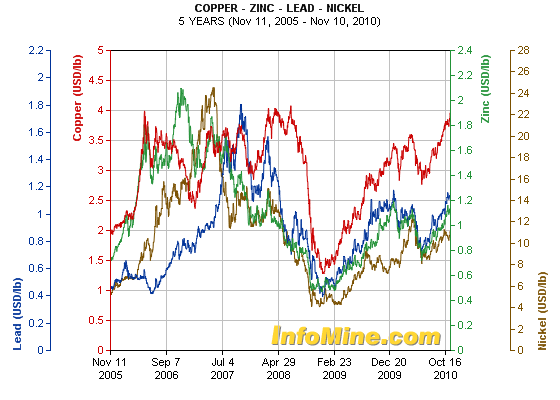
...and you notice that in the last couple of years there's been very little percentage change difference between any of them. Then go to the last month's trading and Dr. Copper, even with all the "broke $4" headlines, has lagged Pb by quite some measure and lies joint third.
Thursday, November 11, 2010
Charts of the day are....
...and you notice that in the last couple of years there's been very little percentage change difference between any of them. Then go to the last month's trading and Dr. Copper, even with all the "broke $4" headlines, has lagged Pb by quite some measure and lies joint third.
Sunday, October 31, 2010
Peru's metals production numbers for September 2010 are poor
Zinc is at the low end of its normal fluctuations.
Lead continues to drop away quite sharply.
Silver numbers aren't that great, either.
Wednesday, September 1, 2010
More Peru mining production stats
Ahhhh I feel better now. Let's plough straight on with the monthly metals production figures for Peru in the period 2006 to date. Starting with copper, the only one that has made some sort of significant move (and I betcha that you can guess when the Cerro Verde expansion came online):
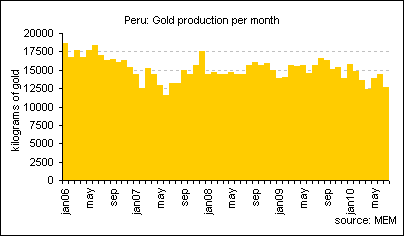
Next gold:

Here's silver:

Here's zinc:

Here's lead:

Here's iron ore:

Here's tin

Here's molybdenum:


Sunday, April 25, 2010
Peru's metals production in the first quarter of 2010 sucked
The thing about economic growth is that it doesn't come along automatically. Despite what Peru's mining industry obviously believes, you tend to need to produce more over a certain time period if you want to grow.
Tuesday, September 8, 2009
What's going on with Lead (Pb)?

Lead (Pb) has really been on a tear recently, as this chart clearly shows.
Yet another sharp jump on the LME this morning moved it up to U$1.12 and bits per pound, this despite inventory levels that are now touching five year highs.
The absolute amount of outage in China is difficult to gauge (and if the local China experts are guessing , that means your humble correspondent has zipsquat idea) but it's clearly larger than DRP, which in itself produces 3.1% of world mined lead per annum (using 2008 figures) and around 1.4% of total world supply (the big difference explained by the fact that a lot of lead is recycled).
So moving forward, word of smelters reopening in either place will move the market more than end demand numbers, at least in the short term. DYODD.
Thursday, June 11, 2009
Peru's metal mining industry: An overview of the year so far
First, here's Peru's total exports for the period in question, January 2009 to April 2009. As we can see, metals make up the majority of everything exported by Peru.
- Total exports Jan-Apr 2009: U$7.09Bn
- Percentage metals in exports: 59.5%
- Percentage gold in exports*: 28.1%
Yep that's right; due to the sinking of copper compared to last year and the value held onto by gold in the period, Au is now Peru's biggest export by far. Also, did you know that nearly all of Peru's production is shipped to Switzerland? I did.
On to the next chart that compares 2008 to 2009. Yep, that's over $2.2Bn in lost exports you're looking at there. but of course, Peru's GDP is growing...............

Next is the breakdown of metals exported in the four months of 2009 and you can see that for all the talk about Peru being the world's biggest silver producer, the third biggest zinc producer and its polymetallic production nature, there are only two metals that really matter; gold and copper. As far as the country's economy goes, the rest are just noise.

Finally, this chart shows just how much metals values have dropped since 2008. The recovery in March/April 2009 compared to January/February is directly related to the recovery in spot copper, of course.

Now we move away from dollar values and look at volumes. The following charts show just how much of each metal has been mined in Peru per month since January 2008. Firstly gold, benefitting from recent production hikes at Yanacocha and Alto Chicama (the two big gold mines in the country):

Now that Cerro Verde is running at full tilt, copper production has been pretty steady.

Zinc production has dropped, probably due to the layoffs and mothballing of smaller mines:

Silver has stayed fairly steady. Buenaventura (BVN), PAAS and other large dedicated silver miners give Ag more stability, even though it's often a by-product more than a product.

Pb production has dropped for the same reasons as zinc; closures and layoffs, with 10,000 miners having been laid off in 2009 (which doesn't affect GDP growth either...oh no)

Tin numbers drooped a little but have remained largely steady:

In iron ore, nearly all the ballgame is Shougang at Marcona in South coastal Peru, so whatever happens there is the country results.

Moly has been hit very hard. Roasting circuits have been turned off and value of Moly sold has dropped by 88% YoY.

So all in all, if it weren't for Switzerland Peru would be in the doo-doo right now. Actually that's a little cynical, because if you're going to be a metals nation and export the stuff to progress and grow, then you couldn't really choose better than to have copper and gold as your big products. Gold has supported the drop in copper all this time, and if the Hoped™ for recovery does indeed happen quickly and world financial winds turn against gold and its safe haven reputation, copper is likely to take up the slack for Peru.
*thanks for the typo pickup, anon
Friday, March 20, 2009
Anyone for a base metals supply squeeze?
- Doe Run Peru (DRP) is currently shut for all operations except its copper smelter supplied by its own 'Cobriza' mine
- DRP is the hub for dozens of small and medium sized Peruvian mining companies. With DRP shut down, a potential supply bottleneck is already forming, especially for lead. DRP processes around 120,000MT of Pb per annum which is around 3% of world supply, as well as zinc, silver, etc.
This could become an almighty cluster----. Peru's unions have already said that DRP should not be bailed out by Peru's government, but that would only mean standstill in many of the mines that supply DRP, not to mention the export activity, revenues etc that come from the smelter output. If Peru does bail out DRP, how much money would have to be flushed down a toxic black hole to keep the mining sector operational? Away from the possible knock-on effects, the US mining industry could be under the same kosh if the parent company is the source of the financial problems and it is not some isolated Peruvian problem at DRP. Then there's the spot market...is this the reason we've seen a 20% rise in Pb spot these last few days (likely, as LME ringtraders are much sharper than I)? Or just maybe this still a black swan and it hasn't been factored in yet.
The above is just speculation so far, folks, so DYODD. To emphasize the point, those two links provided are to Wikipedia pages, and nobody in their right minds makes a definitive decision based on a wiki. But it's certainly a story worth following.
UPDATE: Reuters has more information on an updated report. Check it out.
UPDATE 2: Bloomie is running its own report now, with useful quotes from Peru union people.
Monday, February 23, 2009
Fortuna Silver (FVI.v): An interesting snippet

The Ottoscope™ reports that Fortuna (FVI.v) has hedged around 65% of its zinc (Zn) and lead (Pb) production. The Zn is hedged at around U$1,200/MT (that's U$0.544/lb) and the Pb is around $1,100/MT (that's U$0.499/lb). This means that with the bias toward Zn over Pb at its Caylloma mine, the global average hedge price is a touch under U$0.53/lb. This hedge is for the first six months of 2009 (i.e. it started in January and finishes June '09).
All silver production remains unhedged.
Those who bought the NOBS report will be able to factor in the change to the presumed metals revenues mix. Those who haven't bought the $10 report yet and are interested can find out more here.
Monday, February 9, 2009
Aquiline Resources (AQI.to): Southern scuttlebutt
First the facts: Aquiline (AQI.to) came out with this PR today that sets the company up nicely for its new 43-101 resource due out next month (according to the PR at least). The drilling campaign has clearly been a good one and the company conveys the feeling that the resource is very close to full definition now. The Navidad project is undoubtedly very rich, very big and altogether tasty. It's also got important support from the governor of the Chubut region, Mario Das Neves. backing worth its own weight. Anyway, next month we get to see some hard 43-101 numbers.Now the gossip, rumours and general "don't bet on this stuff" talk. Otto was talking yesterday with a long-time friend in Argentina. Word up from the bowels of BsAs tends to confirm the talk that swirled around a few weeks ago, namely that Aquiline is the target for a large silver player in the immediate future. I want to stress that this is an unconfirmed, anecdotal rumour and so take it as you will, but I'm passing this one on today (instead of leaving the rumour on my desk, as happens with the great majority) as it passes personal tests:
1) The source is one I consider very reliable.
2) It's unlikely to be duplicity from last month's scuttlebutt. Sorry and all that but can't really say why. Suffice to say that the person in question doesn't move in the same circles as the Canadian investment world.
3) It makes sense. The timing before the 43-101 resource is good, and as seen in recent days there are large players looking to buy up the beaten-down juniors in all sectors from copper to gold.
4) I do not own any Aquiline, nor does anyody I know directly. (There's one guy I mail with in Canada that owns heaps of the thing but we haven't spoke since I got back from the beach).
Here's the 12 month chart of Aquiline FYI:
Now listen very carefully: DO YOUR OWN DUE DILIGENCE, DUDE. What I'm passing here is a rumour, no more and no less. I have my opinion about the integrity of the person involved and this post wouldn't exist if I had the slightest doubt on that score. But it's still a rumour. Got it? And as for future positioning, I'm not planning to take a piece of AQI.to personally, either. I'm quite happy with my trading portfolio right now and don't want to move much further out of cash. I'd also feel cheesy after posting like this. Nuff said. Have a nice day.
Tuesday, January 6, 2009
Volcan closes open pit operations
This is a great hi-res shot of the town of Cerro de Pasco. Click to enlarge (it gets big). I think we can say "dominated by mining", no?
Peru's El Comercio today reports that Volcan has shut down its open pit mining operations at its Cerro de Pasco mines (note that underground mining continues at its mines) and has also cancelled 32 of its 64 service contracts with third party companies (many workers are contracted this way, for example). According to the report, 302 workers have been laid off, a number that may be greater due to the service contract cancellations.
Volcan, owned by the Letts family, is one of the longest-standing mining companies in Peru. It's also a rather secretive company about its workings. Although (true to form) the company has made no official announcement, El Comercio did well to get a quote out of an un-named company spokesperson who said that many workers had decided to volunarily resign from the company "as they reached an economically favourable agreement with the company, but these are not sackings."
Whatever. What this means is that the low world prices for zinc and lead (Volcan's main production along with silver) have claimed another victim. In 2007, full year production at Volcan was 335,926MT...that's a lot of Zn, people. The metal that came from the open pit won't be reaching the market any more.
It remains to be seen whether this news gets a greater audience in the mining sphere. Volcan is a big player, but as it only trades on the Lima bourse it tends to get ignored by the retail chat-o-sphere.
Friday, January 2, 2009
Base metals rallying again
On the subject of rallies, the Dakar Rally (ex-Paris/Dakar) starts tomorrow. This edition is being held in Argentina and Chile.
Above is a cool hi-res photo to click on
"I've been down so long, being down don't bother me."
Maybe it's just because they were so low they couldn't go no mo' low, but the base metals complex is starting 2009 in fine style. Charts please, maestro!


Now to watch and wait and see if it holds. Betcha the Peru stock market makes headlines this afternoon.
Wednesday, November 5, 2008
Fortuna Silver provides an update
But I'm sure you'll like:
- improved production tonnage
- more silver from the mine
- even more coming in 2009 (1.4m ounces will be 70% more than this year)
- recovery rates for all metals are improving (now over 80% recovery for silver)
- new copper circuit that adds easy money by-product cashflow
- strong cash position Mr Taylor
- etc etc
All junior miners are not the same. DYODD. Here's a link to the Fortuna website to help you.
Friday, October 31, 2008
Message to Jay Taylor: Enrol for 'Financials 101'
Taylor says sell Fortuna Silver
Fortuna Silver Mines Inc (C:FVI)
Shares Issued 85,331,659
Last Close 10/29/2008 $0.48
Thursday October 30 2008 - In the News
Jay Taylor in the Oct. 16, 2008, edition of Gold, Energy & Tech Stocks tells readers to sell their Fortuna Silver Mines Inc., recently 61 cents. Mr. Taylor said buy three times between August, 2005, and August, 2006, at prices ranging from 61 cents to $1.35. He said sell half on April 16, 2007, at $3.25. Assuming a $1,000 investment for each of the three buys, selling half of the $3,000 investment at $3.25 would have yielded a profit of $3,620. Mr. Taylor upgraded Fortuna to a buy on June 12, 2008, at $1.96. Assuming a $1,000 investment at $1.96, and taking into accounting the remaining $1,500 investment after the April, 2007, sale, selling the total $2,500 investment at 61 cents would yield a loss of $1,229. Mr. Taylor says he is selling this stock because of a rapidly deteriorating global economic environment, and not because of a loss of interest in the company. The newsletter writer has decided to sell those companies in his portfolio which do not have a considerable amount of cash on their balance sheets. By doing so, he hopes to turn these negative markets to his favour or at least avoid further losses. He plans to keep an eye on Fortuna for a possible repurchase when there are signs that the current global decline has abated.
© 2008 Canjex Publishing Ltd.
So, Mr. Taylor is selling FVI.v because it doesn't have a considerable amount of cash on its balance sheet. IS HE TOTALLY MAD? Right now FVI.v has around C$50m in cash, which is more than the company is worth according to market cap (about C$41m). I'm not talking about working capital either (that's much higher), I'm talking about cold, hard cash that FVI.v has tucked away in deposit accounts collecting a useful slice of interest. Not only that, but FVI.v is the owner of a mine that actually makes money...y'know..positive free cash flow. It's not some explorer with no income stream that will continue to fracture cash while it waits for the market to turn again.
If, as is truly the case, FVI.v has more cash than market cap this can only mean one of two things about Jay Taylor:
1) He doesn't have a clue about Fortuna Silver
2) He doesn't have a clue about how to read a balance sheet or financial reports.
And as Taylor did an extensive interview with FVI.v this year (you can see the video at the company website), it seems clear that the guy must know about the company. So therefore the only possible conclusion is that he's a zero when it comes to reading financial reports.
A little knowledge is a dangerous thing, and those that pay Taylor healthy monthly subscriptions for newsletters that contain badly researched and patently false information should muse on that old saw. Call sell on FVI.v if you want, Taylor, but don't write factually incorrect and misleading statements to back up your erroneous analysis. Jeesh, what a dumbass.........