Because it's not in the geographical area of IKN's usual fare, I'd hardly heard anything about Edgewater Exploration (EDW.v) before today and certainly never chased it up. However it's caught my attention this morning because the company has managed to land itself a strong President and CEO in site friend, George Salamis.
For those that recall, Salamis while President of Rusoro (RML.v) ramped up operations very successfully at its Venezuelan mines, bringing production up while hauling cash costs down to very low levels in the first two years of operations. Now out of Venezuela (probably a good thing, all considered) the dudes at this EDW gig have been smart enough to snap up Salamis and get him to run their projects in Ghana and (most probably very soon) in Spain.
IKN wishes Salamis the best of fortune at his new job and will be DDing the stock immediately and passing on thoughts to subbers in IKN57 next Sunday, because if it's good enough for the new guy there it must have something worth looking at. Here's today's NR:
VANCOUVER, BRITISH COLUMBIA--(Marketwire - June 1, 2010) - Edgewater Exploration Ltd. ("Edgewater" or the "Company") (TSX VENTURE:EDW - News) is pleased to announce the appointment of Mr. George Salamis as President and Chief Executive Officer of the Company effective immediately. Mr. Salamis has over 20 years of experience in mineral exploration, mine development and mine operations and was formerly President of Rusoro Mining Limited, a TSX Venture-listed junior gold producer, and CEO of Caledon Resources plc, a metallurgical coal producer in Australia. Mr. Salamis has previously held senior management positions with a number of major mining companies including Placer Dome Inc. and Cameco Corporation.
Edward Farrauto, CFO and Director stated: "We are very pleased to have Mr. Salamis join Edgewater's management team as President and CEO. George has a proven track record in advancing development-stage resource assets, managing major resource production and identifying and acquiring undervalued mining assets worldwide. He brings to Edgewater a wealth of knowledge and experience in international project development and connections to the capital markets that will greatly assist the Company."
Mr. Salamis stated: "I am very pleased to be joining Edgewater Exploration as President and CEO. Edgewater's agreement with Red Back Mining Inc. on the Enchi Gold Project in Ghana gives the Company the opportunity to rapidly advance a strategic land position in one of the most prolific gold regions of the world. We intend to build upon Red Back's successes on the Enchi Project as well as acquire additional advanced stage gold projects that are accretive to shareholder value. In addition, I look forward to successfully completing due diligence and closing on the acquisition of Lundin Mining Corporation's Malpica-Tuy Gold Project in Spain, which includes the advanced-stage Corcoesto Gold Deposit. I believe there is great potential to build on the current in-situ gold resources in this region of Spain." CONTINUES HERE
Nice teeth, nice tie, nice arty photo. Whatever happened to
grimy, dirty unkempt geologists, anyway?
As I mentioned yesterday I was mystified, even taking into account "The Venezuela Factor", that the very positive news release from Rusoro (RML.v) wasn't greeted with more enthusiasm by the market. So being a humble corner of cyberspace that doesn't mope around and prefers to actually do things, yesterday afternoon I got in contact with George Salamis, President of RML.v, and asked him a few questions about the PR (as having once done a longer interview with the dude and all that). Below is the Q&A I had with him. Enjoy.
George Salamis: The Choco 10 expansion scoping study means a lot to us and clearly defines our value to be unlocked. To me, an alternate headline for this morning’s press release would read: “Attention to all mining investors and gold-lovers: Projected NPV’s for Choco 10 alone shown to be triple our current market capitalization”. This isn’t fiction, this is fact. The outcome of this scoping study shows that the combination of an expanded Choco 10 mine and a fully developed Increible 6 gold deposit creates an immense value driving opportunity for our shareholders. These two deposits, together, are company-makers by anyone’s measure. Gold deposits capable of sustaining 500,000 ozs per year, at a relatively low forecasted operating cost and non-nosebleed capital expenditure levels, are extremely rare. There aren’t many large undeveloped gold deposits left on the planet that come with sub-$300 million construction price-tags, as anyone at Barrick, Gold Fields, Anglo Gold or Goldcorp would attest to.
IKN: Personally I found it very positive news, however market reaction was rather flat on Tuesday. Any thoughts about that?
GS: Indeed, this scoping study news was extremely positive; Net Present Values in the $450 million to $740 million range depending on gold prices, projected rates of return above 50%. All very positive news and certainly the Choco 10 expansion scoping study has presented the most economically robust forecast of any mining project that I’ve ever been a part of.
Someone said the other day that Rusoro had become the Rodney Dangerfield of the mining world, “….Can’t get no respect”! I had a good chuckle from this analogy. What I can say from experience is that once the magnitude of this scoping study news is allowed to simmer in the market, this perception will change.
One unnamed journalist was brave enough to mention Km88, Las Cristinas and our Choco 10 scoping study, in the same sentence no less, in a question to me this morning, as in “Your scoping results are good, but surely what you have at Choco 10 and Increible 6 doesn’t stack up to Crystallex’s Las Cristinas gold project”. Well surely it does stack up to Las Cristinas and any other undeveloped world-class ore-body. I reminded said misguided journalist that 1) on an annualized production basis, during our projected life-of-mine schedule, we are projected to produce a lot more gold – 2 to 3 times more - compared to what’s forecasted at Cristinas or any of the other Km88 gold deposits, 2) our estimated head-grades are easily twice that of Las Cristinas and 3) at Choco 10, we’d be expanding off of a mine that already exists and is successfully producing gold now, whereas Cristinas would involve a completely new build, from scratch, at about twice the CAPEX estimated compared to our Choco 10 expansion.
Don’t get me wrong, I think Las Cristinas is a great ore-body, also world-class. Crystallex’s management have done a great job of advancing it to feasibility as did Placer Dome before them (a shameful plug for my old alma mater who also did some excellent work down there). The mining world has this warped fascination with the trials and tribulations of Km88 and I guess it’s because of the 15 plus years of controversy and excessive turf battles surrounding these projects. It’s always frustrating to witness the investor focus on Km88 and related negativity, in contrast to the great things that we have done in the El Callao district at Choco and Increible (and Isidora) during the last year on the gold production and operational end; increasing gold production, lowering costs, many positive changes meriting positive attention.
IKN: Is the growth time schedule to reach 500,000oz Au production feasible right now?
GS:This time schedule is achievable, however we’d have to hit the mark, timewise, on everything that needs to be done in terms of feasibility, permitting and financing for the Choco 10 expansion to 500,000 ozs or more of annual production. This includes resource to reserve conversion by doing detailed in-fill drilling, new resource estimates, detailed engineering studies, environmental studies, etc. We have a lot on our plates and by spelling all this out in a few sentences, I am by no means trivializing the task at hand. Fortunately, Choco 10 is an existing mine located on a permitted mine site, thus we’d expect that permitting the mine and mill expansion would not involve any significant hurdles. And then there’s financing, whereby one could potentially envisage the inclusion of some debt financing, given that our aim is to produce a bankable feasibility study in the end of the day. One should expect that it would be a lot easier to finance a new mine expansion under management with a proven production track record, a proven track record in working successfully with relevant permitting authorities and an outfit who has the Venezuelan government as a significant partner at one of their other gold mines. Anyway, one step at a time Otto, first we start with the in-fill drilling campaign and then move on from there.
IKN: What of Venezuela? All the world is hearing about nationalizations, expropriated properties and companies etc. The general view is that Venezuela is running out of finances and will take over any foreign company that dares to make a profit. Does this concern you?
GS: This is not of concern to us, but it is of obvious concern to mining investors who attribute such a considerable discount to our stock, relative to other gold producers. This is sad really, because the Venezuelan government has been extremely cooperative with us, be it in the management of our 50/50 mining joint venture with them, Venrus, or in the permitting of new projects. When we have had minor disputes in the past with the government, we have always resolved them quickly and amicably. In the entire history of our existence, we cannot point to one incident where we feel the Venezuelan government has short changed Rusoro or have tried to seize assets from us. I can’t see it happening, ever. Can I state this any more categorically? We don’t see nationalization or expropriation as a significant risk for Rusoro and its shareholders. As I’ve said before the perception of political risk, for us, resides only in the market.
IKN: We know that "the Russian connection" is strong in Rusoro, especially with the recent additions of two more Russian nationals to the management team. The perception is also that Russians have an advantage in running a business in the Venezuela of Hugo Chávez. How much do you agree or disagree with that?
GS: The Russian connection is strong in Rusoro and, indeed, having Russians working side by side with our senior Venezuelan management is a definite advantage. In addition to the recent Russian executive management appointments, we employ a lot of very skilled Russian mining engineers, metallurgists and geologists on the ground in Venezuela, in addition to a few Cuban professionals. So “yes” Otto, I strongly agree. We would not have made the tremendous strides that we have in gold mining, in Venezuela, without this.
IKN: I was sent a report with a call recommending RML today that contained the following extract.
Rusoro today released the results of a Preliminary Assessment, also known in the mining industry as a Scoping Study, completed by top-tier mining consultant Micon International. The Study uses US$700/oz gold for its base case, which we will also use in our assumptions, as Rusoro receives a 15-17% discount to the world spot price from the Venezuelan government.
So the question is, is it true RML is paid at a discount to spot for gold produced?
GS: We do indeed sell our gold at a discount to spot gold rates as other producers, past and present, have done in Venezuela for the past several years. This discount is imposed on sales by the numerous licensed gold buying entities who we do business with in-country. Our audited financial statements show these discounts as a cost of sales. This is a fact of life for all of those who produce gold in Venezuela.
Rusoro workforce seen as they take a mid-morning cigarette break and leisurely stroll
Very interesting mailbag Chez Otto between yesterday and this morning, as it seems there are plenty others out there looking at RML.v right now and I had plenty of received comments (thank you) about the Trading Post section of yesterday. So let's just sum up here what I think on the stock right now.
Check out the latest inside trades. Interesting, no?
Apr 23/09
Apr 13/09
Salamis, George
Direct Ownership
Common Shares
10 - Acquisition in the public market
5,000
$0.470
Apr 23/09
Apr 15/09
Agapov, Andre Vladimir
Direct Ownership
Common Shares
10 - Acquisition in the public market
50,000
$0.480
Apr 23/09
Apr 14/09
Agapov, Andre Vladimir
Direct Ownership
Common Shares
10 - Acquisition in the public market
23,000
$0.485
Apr 23/09
Apr 14/09
Agapov, Andre Vladimir
Direct Ownership
Common Shares
10 - Acquisition in the public market
27,000
$0.470
As for the results to come we're about to get the YE'08 filing but what we'll need to zoom in on are the 4q08 numbers and not the whole year. This because the 4q08 quarter's production was stronger, costs lower and also RML wasn't benefitting from the elevated parallel rate for dollars over Bolivares Fuertes (VEF) in earlier quarters.
I think 4q08 is going to look pretty good, but maybe the real deal will be shown in the company's 1q09 quarterly that we'll get in maybe a month's time (an estimate based on typical filing times). Jungledrums tell me that the company has been working full tilt and costs are down, too. That VEF rate is really helping the company now, too.
Even without the GRZ buyout, RML is expanding quickly as its own generic projects are on track, it seems. This of course means that the net revenues won't make it to the bottom line as yet, because they're busy investing what they make. Therefore I personally will be far more interested in the company's EBIT number than the final bottom line or EPS number. You should be, too.
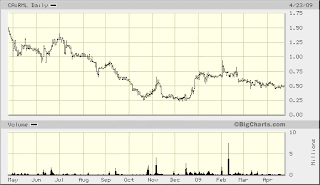
So there you have it; the reasons why I like RML.v right now. You MUST DYODD on this one, dudettes and dudes, because we're talking about a stock in Venezuela, we're talking owners generally unloved by the Canadians (which is reflected in warranted or unwarranted press..you be the judge) and we're talking the recent court case where the beaky guy went against RML and gave his reasons loudly and clearly. In other words, this is by no means a risk free trade. For the record I do not own right now but may pick up a few shares in the next couple of days and will inform in the Trading Post series if I do. It's certainly very high on my shopping list but on the other hand I won't be chasing any prices. Here's the RML 12 month chart.
Oh this is fun, I get to break an exclusive! After hitting "publish" on the trading post underneath I got in touch with George Salamis, President of Rusoro (RML.v) and asked him his views. He told me about what was going on with the courtroom appeal application reported today and I said, "Hey, that's good copy, mind if you go on the record with that?" Here agreed and here's the result. Salamis exclusively told Inca Kola News;
"It's hugely unfortunate that investors view (according to the share price of today) that this appeal represents new life for the bid.
"A couple of things to make clear. One, the bid is dead. We are not entertaining any discussions with, or about, Gold Reserve whatsoever. Two, we were extremely disappointed wth the findings of the court on matters of both fact and law. Accordingly, we have followed through with our public commitment to our shareholders to vigorously defend ourselves. Any success in the appeal will clarify our legal position, but we should be clear; success on this appeal will not trigger the revival of the bid." UPDATE: Reuters playing catchup
An Interview with George Salamis, President of Rusoro Mining (RML.v)
Mickey Fulp is a very connected guy. Thanks to The Mercenary Geologist (check out his website here) your humble correspondent recently got in touch with Mickey's friend George Salamis, the President of Rusoro Mining (RML.v). After some banter about how I didn't seem to like RML.v so much, I asked Mr. Salamis (I called him Mr. Salamis...kept it all formal y'know) if he'd be good to answer a few questions.
"Sure!", he said "ask me anything you like!".
"What, on the record?", I asked.
"Yep...anything you like. On the record, no problem."
Well an offer like that doesn't come around every day, so I did just that and here below is the resulting long interview. I hope you enjoy. Otto.
PS, if you want to know what "salami" means in Spanish slang, drop me a line.
Otto:Hello, Mr. Salamis and thanks for agreeing to do this interview.
George Salamis: Hi Otto, thanks for inviting me to a chat on Inca Kola News. I have been reading it with interest for a few months now.
Otto:So on with the show. Can you tell us a bit about your background as a miner and how you became President of Rusoro?
GS: Well to use an over-used cliché, I guess mining is in my blood. My Father is an accomplished mining engineer and prospector who worked extensively overseas in mine development, often dragging us with him to live in some fairly exotic and remote places. Central America, Africa, Northern Quebec, you name it. Rock and mineral “pop-quizzes” were part of everyday life in our household.
Much to my Mother’s alarm I chose a life in mining as well, graduating as a Geologist in 1989 and going on to work overseas for the likes of Placer Dome, Cameco and others. In 1999, feeling a desire to unleash that pent-up inner entrepreneur, I made the leap from major mining companies to junior mining and have never looked back. Its been great fun and I’ve had the chance to be part of some great mineral discoveries, been part of advancing some great deposits into production and have been involved in some successful M&A transactions – some friendly, others not so friendly.
How did I get involved with Rusoro as President? Well, in mid 2007 a friend of mine rang me up mentioning that he knew of a newly listed company (Rusoro) that appeared to have a strategic edge on developing big gold assets in Venezuela. Rusoro was in need of a President. He mentioned this knowing full-well that I had spent a fair bit of time working for Placer Dome, the previous owners of the gargantuan and infamous Las Cristinas gold project. I walked away from Placer in the mid 1990’s saying to myself, “this place (Venezuela) has probably the best gold potential of anywhere in the world, however working down here is a bureaucratic nightmare. I shall NOT return unless the circumstances have changed”.
Roll the clock forward to 2007; when asked to consider the Rusoro posting I did a lot of due diligence on the Company, the Agapovs and their track record in Venezuela, Rusoro’s in-country management ability, etc. and quickly concluded that if any outfit had a remote chance of working through the bureaucracy, it was Rusoro. They had a track-record of success and if anyone had a valid shot at gold mining in Venezuela, and working cooperatively with the Venezuelan government, it was (and still is) the Agapov’s.
And Otto, “yes”, as you have rightly pointed out on your Blog in the past, the family name "Salamis” does attract the odd snicker down in South America. I tell you, it’s a great ice-breaker when meeting a Venezuelan government person for the first time!
Otto:Ok, so now can you tell us something about the background of your boss, André Agapov? I’m asking you this because on the gossip mill circuit you hear all sorts of things about the Agapovs, both father and son. Can you tell us more about their background and how they’ve become gold miners in Venezuela, maybe laying to rest a few of the rumors along the way?
GS: Here's what I know about them after becoming close friends and working colleagues with both father and son and have confirmed from them personally, corroborated by those who know and have worked for them in the past, etc. Vladimir Agapov, our Chairman, is an aeronautical engineer by training and used to run Aeroflot's North American operations in the bad old days of the Cold War (1980's and early 90's). Based in Montreal, he fought hard to keep Aeroflot’s transatlantic flight routes open in the face of some fairly serious sanctions that were on the go at the time against Mother Russia. This was not exactly a cushy job. Montreal: nice place, however think Siberia in winter, with OK baguettes, good beer and great hockey. In spite of the obstacles Vladimir kept the flight routes open and his planes fueled, even when they didn’t want to sell him fuel for his fleet of Ilyushin’s. A true story of perseverance in my view.
Son André was sent from Montreal to Moscow to school in aeronautical engineering, following in his. Dad's footsteps. Fresh out of school, Andre started a computer business for a brief time then moved to New York and into stock brokerage, owning the first licensed Russian owned/managed brokerage firm with a trading ticket on the NYSE in the 1990's. André sold the business off, did well doing so, and then he and Vladimir headed off to Venezuela to look at resource investment opportunities. He was one of the first Russian business people through the door in 2002-2003 which, by the way, is well before the Kremlin started to show up on the doorsteps of Hugo Chavez’s digs at Miraflores. they invested in a small, private Venezuelan gold mining operation in Bolivar State and actually delivered on promises made to the government regarding mine development, jobs and community support. All of this coming at a time when lawsuits were flying thick and fast with Vannessa Ventures and others on Km88. North American mining companies were fighting things out in international courts to no avail, rather than building mines down there. Along the way the family acquired other interests in other resources (Kaolinite, for example) in Venezuela.
On one of our first encounters, André shared a story with me about how he had spent days and sweated off many kilos of weight in the jungle looking for the original late 1800’s, British constructed mine shaft accesses in El Callao (next door to our Choco 10 Mine). Decades earlier, as a field geologist, I had spent some time looking around for those same old gold workings and shafts. I knew what he was talking about and said to myself “how many CEO’s do you know of who actually spend time in a jungle doing this sort of thing?”. At that moment, I was sold.
I’d like to dispel another popular misconception regarding the Agapovs. They were not given the “silver spoon treatment” in Russia like many of the oligarchs in Russia when the iron curtain fell. They are, in fact, not oligarchs at all. They are simply hard working and serious businessmen with a desire to build mines in Venezuela. Their success has come as a result of hard work and perseverance, a common theme in everything they have done. Ok Otto? So you can put away the John Le Carre novels and toss aside that copy of “Eastern Promises” that you got for Christmas! Does not apply here.
Otto:Wow, that’s a lot of background. So what’s the bottom line here with the Agapovs?
Seriously, if I have to sum up the situation with the Agapovs and the Venezuelan government I’d have to say that they have solidly won the trust of the government, at all levels, because of their history of delivering on promises. Do they benefit from the recently accelerated cooperation between the Russian and Venezuelan governments? Absolutely. However their reputation was solid before the Kremlin ever started sending their sailors to La Guaira for a bit of shore-leave. Do the Agapovs often dialogue with the government? Yes, Rusoro is a JV partner with the government and they have come to us frequently in the past when they have had problems to be resolved in Bolivar State in and around the various mining communities. For example, regarding labor and community unrest at the Choco 10 and Isidora mines under different ownership, we worked hard to overcome these issues under Rusoro ownership and have been successful doing so.
Otto:So let’s talk a little about the company, Rusoro (RML.v). What has happened to RML.v in 2008 and where does it stand as a producing miner today?
GS: 2008 was a hugely important year for Rusoro. It marked a major turning point for the Company and its investors, in terms our transformation from explorer and developer to gold producer. We’ve successfully turned around not just one struggling mining operation after we bought it, but two separate mines in less than 12 months. None of this was easy and we did hit a few speed-bumps along the way in terms of production cost blow-outs which are now behind us. Our last few months of production numbers have hit record levels, November alone was 13,475 ounces, and our per ounce cash costs have gone from the mid $700s in the summer of 2008 to under $400 per ounce. A lot of the turn-around strategies that we implemented in mid-2008 are just now kicking in. Otto, we think these production levels and low costs are sustainable.The new mine fleet is delivering more tonnes to the mill than ever before, the mill is behaving better than ever before, the union bosses are happy, the workers are happy, there is relative peace in the towns around our mines in Venezuela.
Alongside all of this work of successfully turning around a few failing or problem plagued mines, we’ve also been very busy building two new mining operations, San Raphael-El Placer and Increible 6. Both are expected to come on-line in 2009 giving us a further significant bump in our production.
Otto:On the subject of social and work relations, there were news reports about a land invasion by locals on to your Choco IV property just before Christmas that was affecting production. Can you bring us up to date on the situation there?
GS: I wouldn’t necessarily call a few dozen or so small miners moving into an area of Choco 4 to earn a bit of pre-Christmas pocket money a “land invasion”. This sort of thing happens all the time down in Bolivar. Not a material event, not newsworthy especially when compared to the thousands of small miners that have overrun the Km88 area in the past.
The best way to ensure that land invasions of any sort don’t occur is to give these small miners permanent employment and job skills which is something that we do at our mines in the El Callao and El Dorado areas, employing over 1000 people. However, this is something that has been sorely lacking in Km88 and deserves to be fixed. The locals are tired of waiting for something to happen, perhaps even more so than the Gold Reserve investors. This is a situation that we think we can resolve quickly to everyone’s benefit.
Otto: Rusoro of today is all very well, but in the last month the company has been making headlines with its move to buy out Gold Reserve (GRZ). So the question here is more about the Rusoro of tomorrow. What’s your vision for RML.v going forward, Mr. Salamis and how do the GRZ assets fit in?
GS: Shareholders in the gold sector have been ill-served by excessive turf battles for as long as you and I can likely remember.The starkest testament to this folly, especially for those who worked in the mining sector through the 1980’s and 90’s in Canada,is the three shafts sunk into the Hemlo orebody; three companies couldn't find a way to work together and shareholders paid the price.Some strange mix of ego and greed.You don't see this nearly as much in the oil patch, in passing.
It makes eminent sense to put these two companies together.The potential for operational rationalization is obvious. I also believe we could make a contribution towards moving Brisas forward.The project is world class and an excellent compliment to our existing assets in Venezuela. It deserves to move forward.We think we can help here.
I want to say at this juncture that we made determined efforts to do this in a friendly way. Several times during my tenure and, from what I understand, a few occasions before my time.The last thing we wanted was a bun fight. Unfortunately, the management at GRZ did not see things the same way. Now it us up to us to earn the trust of GRZ shareholders. They, the GRZ shareholders, have sunk a lot of money and time and effort into the venture. We firmly believe it makes a lot of sense to combine forces and just get it done. We just as firmly believe we can help and we hope and expect the shareholders will come to view things likewise. There is a huge opportunity to build something here. That's the 30 second soapbox appeal.
Otto: Many Venezuelan mining market watchers have noted the way Rusoro seems to get the permits it needs to operate from the Venezuelan government fairly easily while at the same time companies such as Gold Reserve and Crystallex have languished for quite literally years while waiting for the paperwork to go their way. Why do you think that is so, Mr. Salamis?
GS: Well, I can't speak to the particular situations of GRZ and/or Crystallex; I haven't been privy to the correspondence. But I acknowledge it's been a dreadful trip for most investors in Venezuela’s gold sector.For an exploration destination so endowed as Venezuela, surely there's a way for investors to see a return. A strategy that’s neat and tidy, one that “de-risks” the place in the eyes of the investors. Now there’s an idea!
As for ourselves, speaking very generally, I think cultural affinities have something to do with the way we're seen and accepted. People have a natural tendency to do business with people they feel comfortable with. And so far we feel there is a fairly high degree of mutual comfort between ourselves and the various permitting authorities, the government, etc.
I should also add that we are not unique in this respect. Before us, Gold Fields was also welcomed in-country. Why would that be? Recent South African history helps shed light here. The Company (GFI) had demonstrated its willingness to work with constituencies traditionally left out of the decision making process and was, more generally, alert to sensitivities in-country. This sort of thing makes a difference.
So Rusoro is not unique and there is nothing magical about our success at getting projects moving down there. When in Rome, as the saying goes, do as the Romans would do. And that's what we try to do. So far, so good.
Another question that has come up frequently in conversations over the last few weeks is how we are going to finance Brisas. We shall cross that bridge when we get to it. What is clear from this vantage point, however, is that is will be a lot easier to finance a land position under management with a proven track record in working successfully with relevant permitting authorities than it will be to finance a land position under management with a proven track record of working quite unsuccessfully with relevant permitting authorities. That's what we know right now.
And done correctly, it's an attractive proposition. If we can marry big ounces with a viable framework, that is a framework that gives comfort and confidence that the ounces will in fact get developed, and we think we can, well, that's a nice meal for investors and solves the environmental woes caused by the small miners and rampant unemployment that’s plagued that area for decades. How many gold ore bodies with seven digits of metal are left out there, besides those in Km88 and the ones Rusoro already owns to the northwest in El Callao and El Dorado?
Besides, it not as though there's no bad news in our share price already, yes? The markets could triple and the shares would still trade as though we killed our grandmothers. So some constructive developments on the ground against a backdrop of shares that are already priced for nuclear winter make us think we won't have a problem raising money, debt or equity, and on favorable terms at that. With the government on-side and a partner with some skin in the game, plus our track record of production, one would think that raising debt would be feasible.
Otto: One of the things investors and potential investors always want to know about Venezuela is what it’s really like working there. Is the bureaucracy as difficult as people make it our to be? Is the country so socialist in nature that it’s difficult to make a capitalist-style profit? How do you see political risk going forward? What insights can you give us about doing business in the country?
GS: I wish that I could paint a tremendously rosy picture about operating in Venezuela, this isn’t so. Building and operating mines in Venezuela is not for the faint of heart nor the impatient. Importing equipment and spare parts into the country is doable but slow, as we witnessed during the summer of 2008 causing us a bit of a cost blow-out. That’s when the new haulage fleet that we ordered didn’t exactly show up on time and equipment availabilities were fairly dismal over those months. The bureaucracy is problematic at times and the time factor involved in dealing with this bureaucracy must be built into everything we do when we make plans down there. However, we manage and have succeeded in working within the framework of Venezuela’s socialist development agenda and bureaucracy. And in the last few months we have done so very profitably. In reality these types of issues are not unique to Venezuela in Latin America or other mining regions in less developed countries around the world.
The perception of political risk, for us, resides only in the market and is obviously impacting our share price and that of Crystallex and Gold Reserve, equally. Resolving the Km88 situation in a positive way, having the projects move forward with the Government’s involvement and blessing, would go a long way to lifting the black cloud that has plagued the market’s perception of an incredible gold deposit in what is geologically a world class environment for gold.
Otto: One issue that concerns me about miners in Venezuela can be summed up in the quick phrase “dollars in dollars out.” By dollars in I mean the difficulty many companies have in accessing the official VEF2.15-to-USD1 exchange rate via the government CADIVI body. The result is they have to buy their currency on the more expensive parallel market. The dollars out part refers to the possible hitches you as a gold miner might have in obtaining the full market price for your metal on the world market. Does Rusoro suffer from either “dollar in” or “dollar out” problem, and if so how much of a problem is it for you?
GS: The system in Venezuela is actually beneficial for companies who are able to exchange currency through official channels thereby effectively covering those costs associated with the milling and mining operations paid in local currency.
All gold is sold based on the daily world spot price for gold. We are subject to all applicable taxes and sales charges as in any other country and some of those are recoverable. As for the movement of currency out of the country, mechanisms exist and are in place to allow the transfer of funds out of the country.Like us, many significant foreign companies in many industries use these mechanisms on a regular basis.
You mentioned CADIVI; however sluggish this system might be CADIVI is a huge benefit to us in terms of using in-country exchange rates to benefit the low-cost purchase and importation of goods that cannot be manufactured or bought in Venezuela. Do we suffer at all from “dollar in and “dollar out” problems? No.
Otto:I’ve mentioned my doubts about Rusoro as an investment several times on this blog. In fact, one of the things you and I talked about before you kindly agreed to do this interview was how you’d like to convince me that I’m wrong about my “avoid” call on Rusoro. So here’s your chance, Mr. Salamis! I’m a doubter, make me a believer. Why is Rusoro a good investment today?
GS: Yes Otto, well I’m still debating whether I include you on my Christmas card list or not for being such a pessimist. Essentially you have a company with an exceptional production growth profile, having grown from no production to producing at an annualized rate 150,000/yr in two years. Upon the completion of the current studies for production expansion at the Choco 10 mine and mill, Rusoro foresees this number more than tripling in the future. In the last 12 months the Company has acquired two mines that were struggling in terms of labor issues and in the case of the Choco Mill efficiency issues and turned them around to the point where not only are labor and the Unions happy, but the mill will operate in positive cash flow for the first full quarter in Q4 of 2008 with cash costs well under $400/oz Au. All good.
Add to this that the company will bring two additional mines on stream in late 2009 or early 2010 which will likely add approximately 100,000oz/yr Au in the near term and you get a feel for the production growth profile near and mid term. Longer term Rusoro will continue its exploration and asset consolidation efforts in this enormously gold rich region, hopefully with Brisas as the next addition.
Without the political risk that has plagued us in the market, where should the company trade?You can decide this based on you own comparative analysis, but the answer is certainly higher. We feel we are making headway on the extent of the perceived political risk by embracing the JV model preferred by the Venezuelan Government.Resolving the Brisas situation goes a long way down the track of “de-risking” Venezuela in the eyes of the investment community. We now have several JVs with the Government, the most significant being at the Isidora Mine. In our minds the best way to significantly lessen the perceived risk moving forward is to lift the black cloud that is Km88 and in the last month we have become proactive on that front, rather than sitting back to watch the situation worsen.
Certainly the quality of Rusoro’s assets are not fully realized in the market. If you are an investor who likes to rely on underlying fundamentals and growth potential you have a company whose fundamentals are improving on a monthly basis and that has a production growth profile and resource portfolio which leads its peer group. We are certainly not a one-asset Company. For speculators who wonder “what if” concerning the Km88 region you have a company, Rusoro, that is committed to consolidating a world class gold region and that has had success so far in doing just that.
You are essentially asking me how you can eliminate the political risk for you and the truth is you can’t completely eliminate it in any developing region in the world.We do believe however, that we are on the road to significantly lowering it and I can best sum up where the Company is at as follows; Rusoro is a company with exceptional production and growth prospects, with improving fundamentals and significant blue sky in partnership with the ultimate decision maker in the region.Can I take my Bay St. Howe St. beret off now, Otto?
Otto: You sure can. Thanks again for agreeing to do this interview with IncaKolaNews, Mr. Salamis. Are there any final words you like to say to our audience?
GS: Enough said for now, Otto. Many thanks for letting me bend your ear!