
Showing posts with label Machu Picchu. Show all posts
Showing posts with label Machu Picchu. Show all posts
Tuesday, August 2, 2011
Monday, August 1, 2011

Saturday, July 30, 2011

Friday, November 19, 2010
Machu Picchu and Yale University Controversy
About 5,000 artifacts taken from the ancient Incan city of Machu Picchu in Peru nearly a century ago.
Peru says Yale to return Machu Picchu relics. November 19, 2010.
Click the figure below to see a compilation of news stories (years 2010 - 2007).
![]()
Peru says Yale to return Machu Picchu relics. November 19, 2010.
Click the figure below to see a compilation of news stories (years 2010 - 2007).
Monday, November 15, 2010
Wednesday, August 4, 2010

Friday, July 16, 2010
Inca Trail to Machu Picchu: Dead Woman's Pass, Warmiwanuska, Sign at 4,215 m (13,829 ft).
The Inca road system was the most extensive and highly advanced transportation system in pre-Columbian South America.
Inca Trail to Machu Picchu: sign at Warmiwanuska, 4,215 m (13,829 ft)
Click the figure below to see the video.

See also:
The Inca Trail: Warmiwanuska
The Inca Trail - Index
The Inca road system was the most extensive and highly advanced transportation system in pre-Columbian South America.
Click the figure below to see the index.

See also:
The Inca Trail
Inca Trail to Machu Picchu, Dead Woman's Pass
Video
Inca Trail to Machu Picchu, Celebration at Dead Woman's Pass
Click the figure below to see the video.

See also:
Inca Trail to Machu Picchu
Inca Trail to Machu Picchu, Celebration at Dead Woman's Pass
Click the figure below to see the video.
See also:
Inca Trail to Machu Picchu
Friday, June 18, 2010
Machu Picchu 3D, Google Earth
Index
A detailed 3D Google Earth model of the ancient Inca city of Machu Picchu has been created using data from a laser scan of the site conducted by the University of Arkansas.
Click the figure below to understand the form and scope of Machu Picchu.

See more:
Machu Picchu 3D, Google Earth
A detailed 3D Google Earth model of the ancient Inca city of Machu Picchu has been created using data from a laser scan of the site conducted by the University of Arkansas.
Click the figure below to understand the form and scope of Machu Picchu.
See more:
Machu Picchu 3D, Google Earth
Saturday, April 10, 2010
Machu Picchu and Yale University Controversy
Peru drops six of the 17 charges filed against Yale in its 2008 lawsuit demanding the return of ancient Inca artifacts removed from Machu Picchu by Yale professor Hiram Bingham III.
Click the figure below to view the illustration.

See more:
Machu Picchu and Yale University
Click the figure below to view the illustration.
See more:
Machu Picchu and Yale University
Wednesday, February 3, 2010
Peru's tourism industry facing crisis
 I picked a hi-resolution photo, so if you were planning to go this year you
can now click on the above, download and tell your
friends how great is was without leaving the beach.
After the rains comes the perfect storm. The flooding and chewing-to-bits of the rail connection to Machu Picchu has isolated Peru's jewel in the tourist track crown and according to latest reports the citadel will be inaccessible for the next seven to eight weeks. However, the new accesses that will open are footpath only, because they're now talking about five months to get the rail line back up and running.
This is not just a problem for Cusco. The two days (or so) that tourists spend at Machu Picchu form part of a whole circuit that runs typically for two weeks and shuffles coachloads of gringos from Lima-to-Paracas-to-Arequipa-to-Lake-Titicaca-to-Cusco and then flies them back to Lima. So with the main event now cancelled, tourists are turning their back on the whole deal because going all the way to Peru without getting to see the star attraction just doesn't appeal the same way. The result? In the last few days, foreign tour operators have cancelled no less than 50% of all their tour packages, leaving hotels all along the circuit facing empty rooms and tour guides with nobody to tour.
A quick ciggypack calc done yesterday by your humble scribe and a couple of pals who do numbers better than himself put the loss at about 0.5% of projected country GDP. This isn't a disaster in itself, but that money isn't part of the big purse run by the government; it's cash that goes directly to the populations of some of the poorest parts of the country and supports a whole range of service and ancilliary industries (the families that rely on market stalls selling trinkets to people wearing backpacks are in for the tough time, for example). All this on top of flooding that has cost the subsistence farmers of the high plains to the tune of eight million soles and wiped out crops for around 20,000 farmers, according to the Agro ministry.
Moral of this story: Don't build your railtrack next to a river in the high Andes.
Friday, January 29, 2010
Going to Peru to do Machu Picchu soon?
Then make it via the Inca Trail, cos the train is out of action for two months, according to El Comercio today. Above photo from here

It must have been tough for the cossetted gringo tourists to have had to experience what Peru minus comfy transport, plentiful food and warm beds is really like...FOR TWO WHOLE DAYS, TOO! Poor souls. Mind you, the other side of Peru was in evidence too, as two Chilean tourists stuck there told how they paid a U$300 bribe to their travel agency to get them out on one of the helicopter rescue flights before the supposed first flyers of elderly and sick. Viva investment grade, baby....

It must have been tough for the cossetted gringo tourists to have had to experience what Peru minus comfy transport, plentiful food and warm beds is really like...FOR TWO WHOLE DAYS, TOO! Poor souls. Mind you, the other side of Peru was in evidence too, as two Chilean tourists stuck there told how they paid a U$300 bribe to their travel agency to get them out on one of the helicopter rescue flights before the supposed first flyers of elderly and sick. Viva investment grade, baby....
Wednesday, January 27, 2010
The difference between the flooding in the Peru highlands region last year and the flooding this year is....
...that a bunch of gringos got trapped at Machu Picchu this year. Thus it's headline news. Last year it was just a load of poor peasants that got their houses washed away, so who cares, right?
Wednesday, September 2, 2009
Machu Picchu is not real
 it's that photo again. Click to enlarge, it's a hi-res and
gets very big....you can almost see the hotdog stands
Best-selling travel writer Bill Bryson has a new book out called "The Road Less Travelled" which checks out a thousand places to visit that are off the beaten track. But part of the book is devoted to the world's five most over-rated tourist sites and Peru's Machu Picchu makes that list. Here's the UK Times' report on that section of his book (note £100= U$160, more or less).
MACHU PICCHU, PERU
THE BUILD-UP There’s no doubt that Machu Picchu holds its own as a premier tourist stop. Possibly South America’s most-promoted destination, it has held the top spot for travellers eager to see the majesty of the Inca for several years.
THE REALITY The journey to Machu Picchu is not pleasant, and the entrance fee has risen to more than £25. Add to this the round-trip train fare to the village at the foot of the mountain (the most common means of transport from Cusco), the bus fare from here to the site, plus the food and water you’ll need during the day, and you’re well above £100 before you’ve even set foot in Machu Picchu. . .that is if you fall within the number of people allowed in daily.
And y'know what? It's true. For one thing Machu Picchu is over-rated as a destination. For another, there are other places less well-known that are steeped in just as much history in the ex-Inca (and pre-Inca) regions of the Andes. Peru, Ecuador, Bolivia all have their historical jewels to offer. Machu Picchu is the touchstone place and people travelling 10,000km or more to get to South America feel obliged to make it a stop-off on their way. Yes, the place is well-tended. Yes, the tour guides are very knowledgeable and professional. Yes, it's a tourist trap, and an expensive captive-audience one at that. Want to pay Tokyo prices for mediocre goods and services in the middle of smalltown South America? Aguas Calientes is the place for you. Want to buy a genuine Inca ballpoint pen? Cuzco's Plaza de Armas awaits with open arms. Machu Picchu (and Cusco for that matter) is another great location covering itself with plastic and pretending to be something it isn't. Man, gimme La Paz (Bolivia), Medellín (Colombia), Tucumán (Argentina) or Asunción (Paraguay) any day of the week. Real places, beautiful places, places not trying to fake themselves to conform to an image created for outsiders.
Tuesday, March 17, 2009
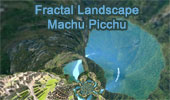
Fractal Landscape of Machu Picchu
Machu Picchu is a pre-Columbian Inca site located 8,000 ft above sea level. It is situated on a mountain ridge above the Urubamba Valley in Peru, which is 50 miles northwest of Cuzco and through which the Urubamba River flows. Often referred to as "The Lost City of the Incas", Machu Picchu is one of the most familiar symbols of the Inca Empire.
Read more at:
gogeometry.com/education/machu_picchu_fractal_landscape.html
Level: High School, SAT Prep, College geometry
Friday, November 7, 2008
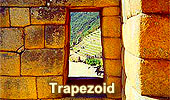
Trapezoid
Machu Picchu
In architecture the word trapezoid is used to refer to symmetrical doors, windows, and buildings built wider at the base, tapering towards the top. Below: A window in Machu Picchu.
Continue reading at:
gogeometry.com/geometry/trapezoid_index_quadrilateral_2_side_parallel.html
In architecture the word trapezoid is used to refer to symmetrical doors, windows, and buildings built wider at the base, tapering towards the top. Below: A window in Machu Picchu.
Continue reading at:
gogeometry.com/geometry/trapezoid_index_quadrilateral_2_side_parallel.html
Subscribe to:
Posts (Atom)